
Music
Repertoire
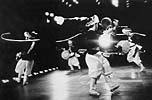 The most important repertoire for the Samulnori is 'Pinari,'
Samdo Seolchanggo,' 'Samdo Nong'akkarak,'
and 'P'ankut.' These are the 'golden pieces,' which have made Samulnori
what it is today. However, Samulnori is far from being content with only these numbers. As in its
past, they are constantly seeking new ways to express themselves through countless concerts of
experimental compositions and crossovers with other types of music.
The most important repertoire for the Samulnori is 'Pinari,'
Samdo Seolchanggo,' 'Samdo Nong'akkarak,'
and 'P'ankut.' These are the 'golden pieces,' which have made Samulnori
what it is today. However, Samulnori is far from being content with only these numbers. As in its
past, they are constantly seeking new ways to express themselves through countless concerts of
experimental compositions and crossovers with other types of music.
Pinari
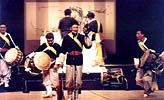 Among the four major pieces for Samulnori, the 'Pinari' is most akin to
a religious ritual, containing words of calling the spirits and asking for their blessing. This is
why Pinari is the first piece to be performed in a concert. The spirit of invitation and
blessing of the Pinari is expected to spread good luck to the rest
of the audience. In the beginning of the concert, the performers enter from a back door, playing
their instruments as they proceed to the stage.
Among the four major pieces for Samulnori, the 'Pinari' is most akin to
a religious ritual, containing words of calling the spirits and asking for their blessing. This is
why Pinari is the first piece to be performed in a concert. The spirit of invitation and
blessing of the Pinari is expected to spread good luck to the rest
of the audience. In the beginning of the concert, the performers enter from a back door, playing
their instruments as they proceed to the stage.
This process is a re-creation of the traditional
ritual called Mun-kut which had been performed at the front gate of a household. The Mun-kut
for Samulnori begins as the Puk plays the signaling patterns, followed by a clamoring response
from the rest of the instruments. Then the Sangshoi (leader of the band) calls out:
" Open, open the gate, ye Generals of the five directions! As we humans enter this gate, all
the fortunes in the world are tumbling in as well." Marching to the 'Tongdaekung' rhythm, the
band then proceeds through the aisle, past the audience's seats, and climbs on stage. The performers
will then pay tribute at the altar and begin playing the Pinari.
Samdo Seolchanggo Karak
The story of the Pinari accounts the genesis of the universe, followed by words of exorcism and
blessing. 'Samdo Seolchanggo Karak' juxtaposes the essential rhythmic
patterns of past janggu virtuosi from the three main provinces of Korea. It is arranged in a
way congenial to modern taste and contains some of Kim Duk Soo's own rhythmic creations. In contrast
to a traditional Seolchanggo piece, the piece arranged for Samulnori resembles the 'slow to fast'
procession of a Sanjo. Also, while a traditional janggu piece is more an opportunity for the
leading janggu player of the band to show off his original style of dance, the Samulnori version,
performed in a seated position, puts more emphasis on the dynamics and the refinement of the overall
musical sound.
Samdo Nong'ak Karak
'Samdo Nong'ak Karak,' perhaps the most well known of all Samulnori pieces,
is an arrangement of the representative rhythms from all around Korea, performed in a seated position.
The three separate pieces called 'Yangnam Nong'ak,' 'Uddari P'ungmul,' and 'Honam Udo-kut' performed
in the early years of Samulnori were later compiled into this single piece. While the Samdo
Seolchanggo Karak captures the essence of the janggu, the Samdo Nong'ak Karak
highlights the contrasting timbre and nature between the gongs and the drums, arranged in a way that
embodies the principle of winding, bending, and blending exemplified in the works of nature themselves.
P'ankut
If Pinari is religious, and Samdo Seolchanggo Karak and Samdo Nongak Karak are
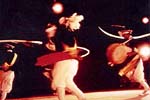
musical, then one could consider P'ankut to be the most playful. During
P'ankut, the performers engage every part of their bodies in arousing the feeling of synmyong
(enthusiasm) among the spectators. With Sangmo hats on their heads and instruments in their
hands (or on their bodies), the performers dance with their souls and bodies. Nothing more exemplifies
the harmony among heaven, earth, and man. Many call P'ankut the
quintessence of Samulnori.
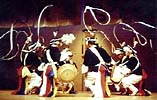
Aside from the four pieces mentioned here, many other pieces have resulted from Samulnori's constant efforts to combine with other music and art genres. 'A Korean Orchestral piece for Samulnori,' 'Samulnori & the Piano,' 'Samulnori Concerto,' and 'Samulnori and Jazz' are some of the most well-known examples.